Stringer vs block pallets
A stringer pallet holds its deck on long boards, the stringers, that run the length of the pallet. A block pallet holds it on nine blocks with stringer boards between them. Stringers are simpler and cheaper; blocks let forks and jacks in from every side and stand up to more handling.
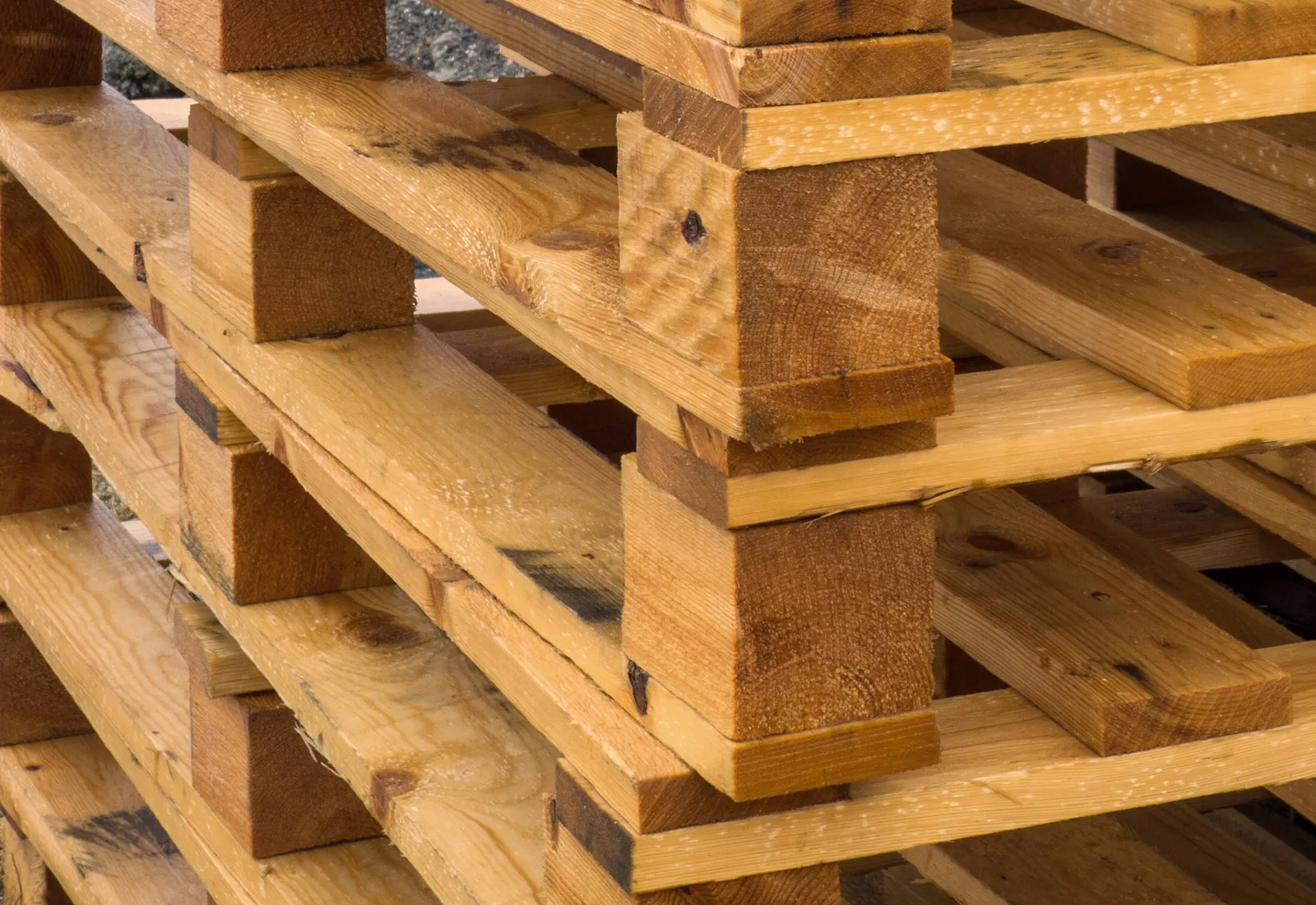
| No. | Member | What it does |
|---|---|---|
| 1 | Top deck boards | Run across the stringers; count and width set the deck coverage. |
| 2 | Lead boards | The deck board on each outside edge, top and bottom. |
| 3 | Notched stringers | Cut-outs in the outside and centre stringers let forks enter from the sides: partial four-way entry. |
| 4 | Bottom deck boards | Placed clear of the notches so the forks can pass. |
The stringer pallet
Most US pallets are stringer pallets; one large supplier puts it at more than 80%. Three or more stringers, usually about 4 inches high and 3 wide in a common 48 x 40, run the length of the pallet. Deck boards are nailed across them top and bottom. Forks enter at the two ends, between the stringers. Cut notches in the stringers and forklifts can enter from the sides too, though pallet jacks still can’t, because their wheels would hit the bottom deck.
The stringer pallet is economical in lumber and labor, easy to repair, and strong along its length. It is the default for one-way shipments and for most distribution freight.
| No. | Member | What it does |
|---|---|---|
| 1 | Top deck boards | Nailed to the stringerboards across the blocks. |
| 2 | Lead boards | The outside deck boards, top and bottom. |
| 3 | Blocks | Nine posts between the decks; forks enter on every side. |
| 4 | Bottom deck boards | Run both ways on many block builds, which helps on conveyors and racking. |
The block pallet
A block pallet replaces the long stringers with nine blocks, three by three, joined by stringer boards on top and a bottom deck that usually runs both ways. Because there are open gaps between blocks on all four sides, forklifts and pallet jacks can enter from any of them. That is true four-way entry. Block pallets are generally stiffer across their width and take repeated handling well, which is why pooled pallet systems use them.
The cost is more parts and more labor, so a new block pallet usually costs more than a stringer pallet of the same footprint and capacity.
Which to choose
Choose a stringer pallet when forks come in from the ends, or from the sides by forklift only, and the pallet makes one trip or a few. Choose a block pallet when pallet jacks must enter from every side, when the pallet is reused many times in a closed loop, or when it is racked across its width. For a heavy load, either can be built strong enough; it comes down to handling.
What we need to know
Tell us which sides the forks and jacks come from, whether the pallet is racked and how, and how many trips it makes. Those three answers usually settle it.
Strength in each direction
A stringer pallet is strongest along its stringers. Lift it from the ends and the stringers carry the load like beams; rack it with the stringers across the beams and the same is true. Lift or rack it the other way, across the deck boards, and the boards alone carry the load, which they do less well. A block pallet’s stringerboards and bottom deck run both ways, so its strength is more even in every direction. That evenness is part of why automated warehouses favour it.
Repair and life
Both kinds can be repaired. A cracked stringer is replaced or plugged; a split block is swapped out. Block pallets used in pools are built to be repaired many times over a long life. A new stringer pallet for one-way freight is built for one trip and an occasional second.
Weight and lumber
A block pallet usually uses more lumber than a stringer pallet carrying the same load, because of the stringerboards and the two-way bottom deck. Blocks may be solid wood or, on some builds, composite. More wood means more weight and a higher price, so specify blocks where the handling needs them, not by habit.
Mixing them
Warehouses that run both often keep them apart, because stringer and block pallets stack and rack differently. If you use both, tell us how you separate them; a mark or a different deck pattern can make it obvious at a glance.
Signs you chose the wrong one
Pallet jacks gouging and splitting the bottom boards of notched stringer pallets mean the handlers need side entry the build doesn’t give: a block pallet would stop it. Block pallets leaving on one-way shipments and never coming back mean you are paying for durability you don’t use. Racked pallets sagging across their width suggest the boards are carrying load that a stringer or stringerboard should carry. Each of those is a reason to revisit the spec, not just reorder it.
Questions to settle first
Which equipment touches the pallet, from which sides, how many trips it makes, and whether it goes into racking or automation. Answer those four and the choice usually makes itself.
Safety on the floor
Whichever you choose, damaged pallets are a hazard: broken boards trip people, protruding nails cut hands and tear packaging, and a cracked stringer or block can drop a load from a rack. Inspect pallets before reuse and pull damaged ones out of service. A new pallet built to a sound spec removes most of that risk for its first trips.
Repair and reuse
Stringer pallets are easy to repair: a cracked deck board is pried off and replaced, and a split stringer can be plated or swapped. Block pallets have more joints, each a place that can loosen, but every part is short and simple to change. For one-way freight, repair doesn’t matter. For pallets that circulate in a closed loop between your own buildings, ask how each design will be kept in service before choosing, and who pays for repairs and replacement boards. Block pallets also weigh more, which adds freight on every trip, and cost more to build, since each needs more parts and labor.
Neither construction is better in general. Stringers win on economy and simplicity, blocks on access and toughness, and your route through docks, aisles and trailers picks between them.