New pallets for automotive parts
Parts move from suppliers to assembly lines on a schedule measured in hours, in containers sized to the line. The pallet under them has to match the plant’s requirement exactly, every load.
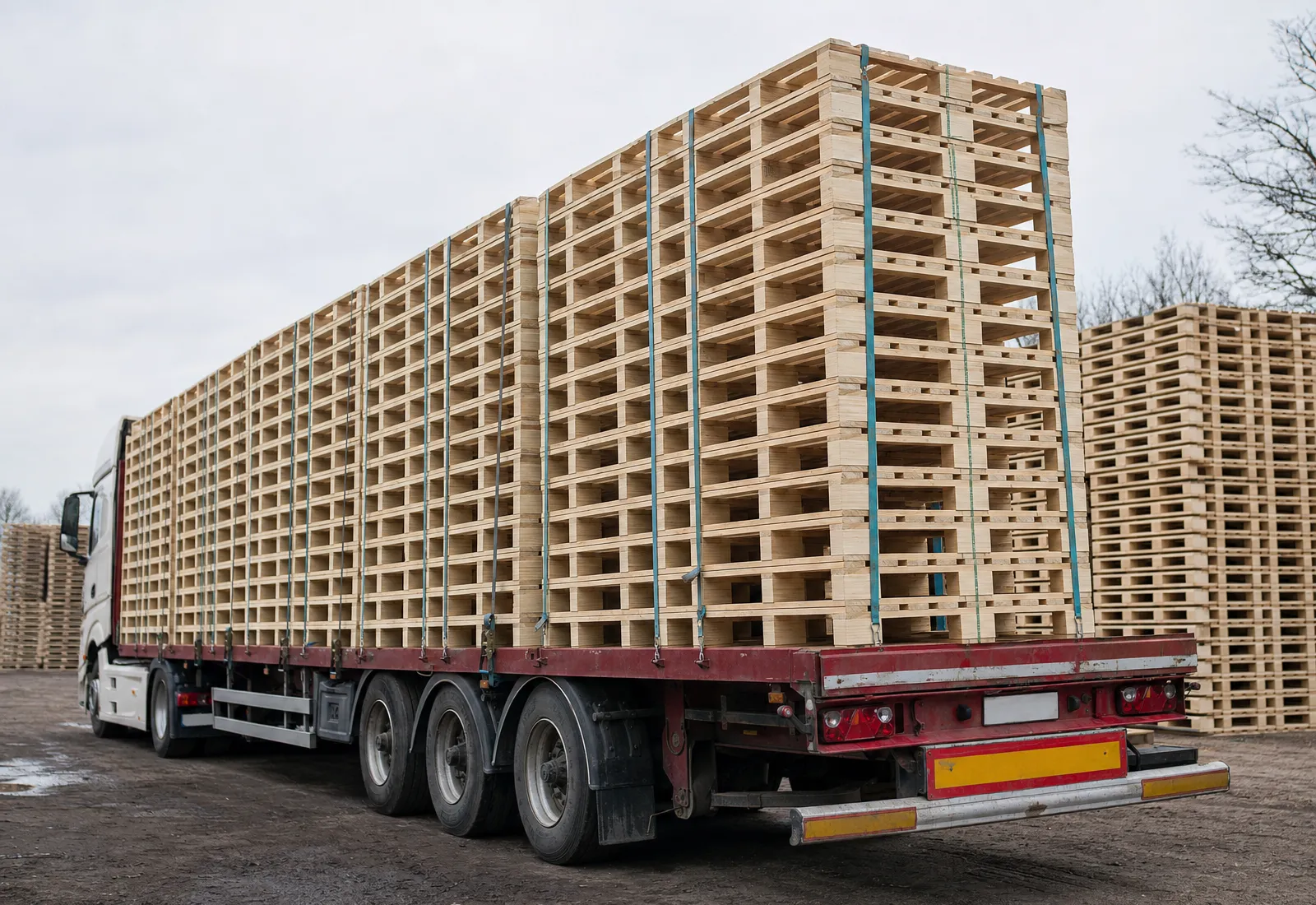 Illustrative image
The load
A parts load is usually a corrugated container, a returnable plastic tote stack or a steel rack holding stampings, castings, harnesses or trim. The weight runs from light plastic parts to dense castings that put a lot on a small footprint. Assembly plants publish packaging requirements for incoming parts: the footprint, the overall height, how the load is labelled and wrapped, and often the pallet itself.
The 48 x 45 is the size listed for the automotive industry and ranks seventh in North American production. Plants also take 48 x 40s and their own odd sizes for particular parts.
Matching the requirement
Send the receiving plant’s requirement with your request. We write the pallet down to it line by line, footprint, height, deck coverage and lumber, so the pallets match from the first order to the hundredth. If a load is rejected at a plant dock, the line is down, so a pallet that varies is not a cheap pallet.
Weekly volume
Suppliers ship on a fixed schedule, so most parts pallets are standing orders: the same spec, the same count, every week. By the truckload covers how a repeat order is set up.
Where parts are made
Motor vehicle parts manufacturing employed 521,212 people in 2025, concentrated along the corridor from Michigan south through Ohio, Indiana, Kentucky and Tennessee. Wayne, Macomb and Oakland counties in Michigan each had over 16,000 parts jobs.
Questions buyers ask
- Can you follow a supplier packaging manual?
- Yes. Send the manual or the relevant pages. We write the pallet lines from it, footprint, height, deck coverage, entry, lumber and marking, and flag anything the manual leaves open so you can confirm it with the plant.
- What about returnable racks and steel containers?
- Many parts travel in steel racks or plastic totes that sit on their own feet and need no pallet. Where a wood pallet carries them, its boards go under the rack’s feet, and the deck must take the concentrated weight of a loaded steel frame.
- Do parts pallets need export treatment?
- Only when they cross a border. Parts moving between US, Canadian and Mexican plants have their own rules: Canada currently exempts wood packaging from the continental US, and Mexico applies its own standard, NOM-144. Name the destination and we put the right treatment on the spec.
- Tires and wheels?
- Tires stack in columns and wheels in layers, often on large footprints. Send the stack pattern, the count and the weight.
- Can pallets carry plant labels?
- Plants often require a label or placard in a set place on the pallet or load. Tell us where it goes, and whether the pallet needs a smooth, wide board there for it to stick or staple.
Quote automotive parts pallets
Attach or describe the plant’s requirement and your weekly count.
- Industry
- Automotive parts
- Pallet size
- 48 x 45 or the plant’s size
- Load weight
- Per pallet, in pounds
Not sure of a line? Leave it blank. Size, load weight and quantity are enough to start a quote.