How new pallets are made and sourced to your spec
A new pallet is lumber sawn into cut stock, nailed to a design. We start from your spec and source the build from pallet manufacturers who cut and assemble it to that drawing.
 Illustrative image
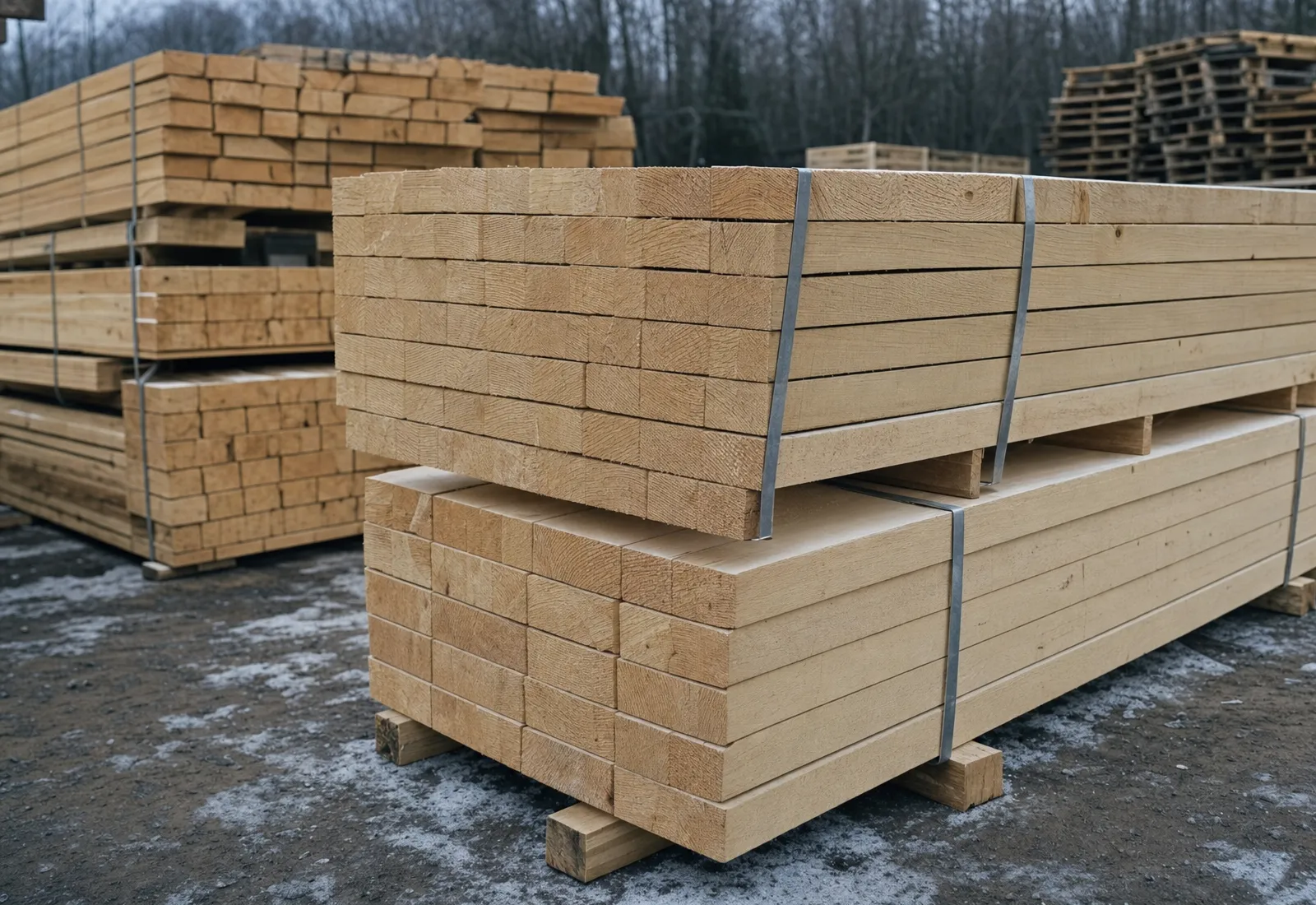
Pallet manufacturing is a lumber trade. Mills saw logs into boards; pallet plants cut those boards into what the trade calls cut stock or shook: stringers and deck boards at set lengths, widths and thicknesses, banded into bundles. Assembly lines then nail the stock together to a design, and the pallets leave stacked by the truckload.
Pallets take a large share of the wood the country cuts. Pallet production accounts for 43% of hardwood and 15% of softwood used in the US. Lumber is bought by the board foot, 1 x 12 x 12 inches of wood, and by the thousand board feet, or MBF, which is why the lumber in a build drives most of its price.
From the design sheet to the stack
Before a new build is cut, it is drawn. A design sheet shows the pallet in plan and side view with every member listed: the stringers or blocks, the top and bottom deck boards, the lead boards on each edge, and the nails. Manufacturers check the design against the load in PDS, the Pallet Design System software the industry uses to size lumber to a target load, so the boards are no thicker than the load needs and no thinner.
That sheet is the spec. Once it is settled, the same pallet can be made again and again, order after order, from the same lumber and the same nailing.
How we source to your spec
We don’t sell pallets from a stock pile. We take your load and handling, write the build down with you, and source it from pallet manufacturers who cut and assemble it to that drawing for delivery to you. Which manufacturer builds it depends on the lumber, the footprint and where the pallets are going.
You get the spec in writing with the quote. If a later order needs to change, the change is made to the spec first, so the pallets on your dock match the pallets you priced.
New, never used
Every pallet is new: built from all-new lumber, never shipped on. Recycled and combo pallets, which mix used and new boards, are a different trade with different strengths. When new is worth the cost over used is covered in new vs used pallets.
Moisture and mold
New lumber carries water. Wood below 20% moisture content won’t support mold, mildew, decay or fungus, and moving air helps stored pallets stay that way. Heat treatment for export does not make wood immune to mold: heat-treated pallets loaded into a trailer while still warm are prone to it. If your pallets will sit closed up in a van or container, say so and drying is written into the spec.
Quality you can check
Because every build is written down, it can be checked. When pallets arrive, measure a few: footprint, height, board count, board thickness, stringer size, notches. They should match the sheet. If they don’t, the sheet is what we answer to. For exports, the ISPM 15 mark on two opposite sides shows the treatment, the country code and the producer’s number.
Pallets for automated lines can also be checked for squareness and flatness on arrival; give tolerances if your line has them.
Any shortfall is answered against the written sheet. Photographs of any problem, with the order number, help settle it quickly.Comparing quotes fairly
Price differences between pallet quotes usually hide spec differences: thinner boards, fewer nails, wetter lumber, a missing stringer. Put every bidder against one written sheet and the comparison becomes simple. Ask each to confirm in writing that they priced the sheet as written, and note anything they changed.