Custom pallets, worked out from what they carry
A custom pallet starts from the product, not from a stock size. We take the load, the footprint it needs and how it is handled, write the build down and quote new pallets to it.
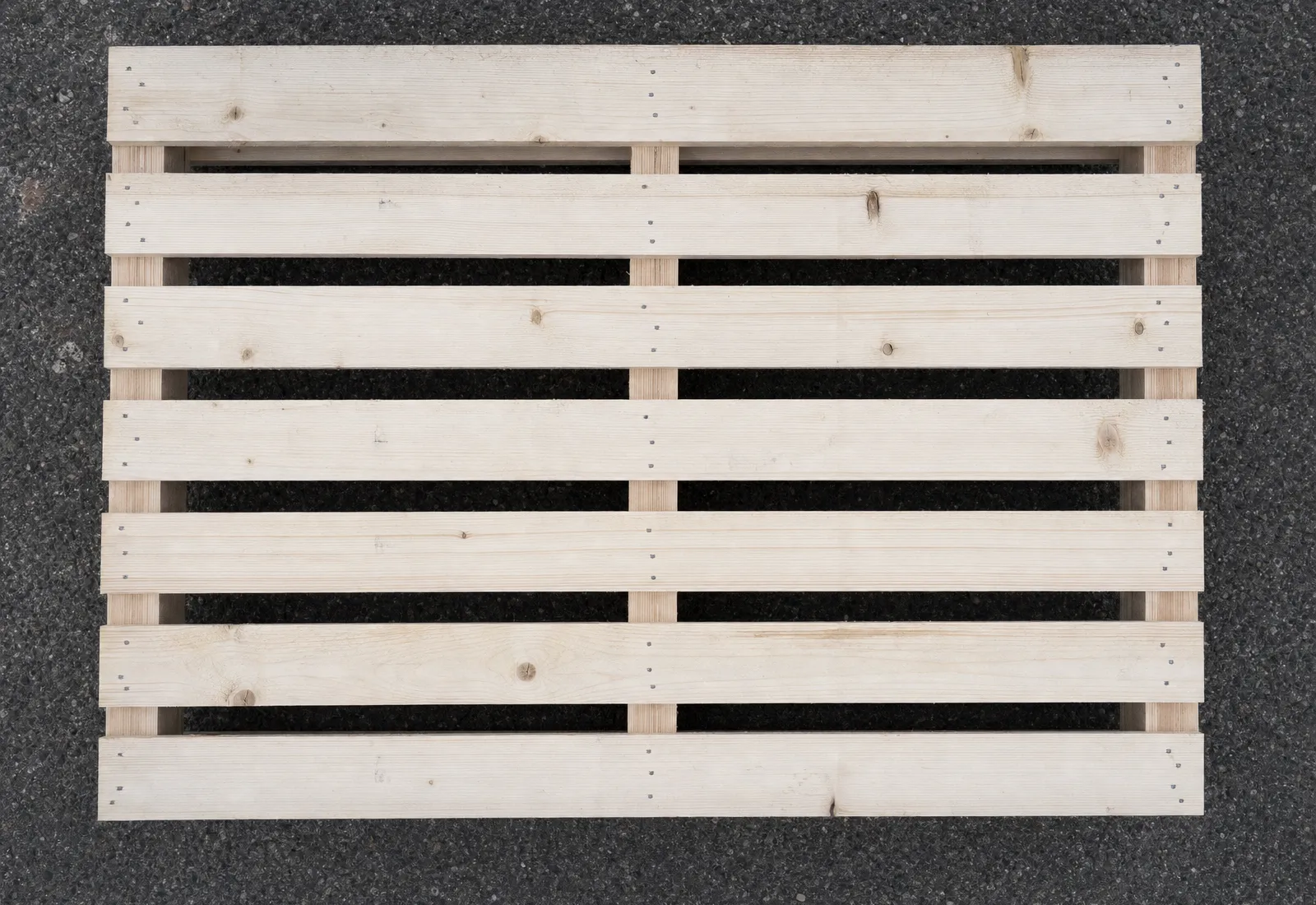 Illustrative image
Buyers come to a custom pallet for one of three reasons. The product doesn’t fit a 48 x 40: it overhangs, which crushes the edge cartons, or it is so much smaller that it slides. The load is unusual: a machine on four feet, a coil, a stack of glass or stone that puts its weight on a few points. Or the handling is: a conveyor that needs a full bottom deck, racking that spans the pallet across two beams, a customer whose dock takes only one size.
In each case the answer is the same work. The footprint is set from the product, the stringers and deck boards from the weight and how it sits, the construction from the handling, and the lumber from all three. That is what a pallet design sheet records, and it is what we put in writing before we quote.
| No. | Member | What it does |
|---|---|---|
| 1 | Top deck boards | Run across the stringers; count and width set the deck coverage. |
| 2 | Lead boards | The deck board on each outside edge, top and bottom. |
| 3 | Notched stringers | Cut-outs in the outside and centre stringers let forks enter from the sides: partial four-way entry. |
| 4 | Bottom deck boards | Placed clear of the notches so the forks can pass. |
What a custom spec holds
A custom spec answers six questions, the same ones a design sheet answers:
- Footprint: stringer length first, then deck-board length. 54 x 44 means 54-inch stringers and 44-inch deck boards.
- Load: the weight per pallet, and whether it is spread across the deck or sits on a few points.
- Handling: forklift or pallet jack, which sides they enter from, and whether the pallet is racked, floor-stacked or run on a conveyor.
- Construction: stringer or block, the number of stringers, and notches if forks need to come in from the sides.
- Deck: the count, width and thickness of the deck boards, the gap between them, and the lead boards on each edge.
- Lumber and treatment: pine or hardwood, and heat treatment with the ISPM 15 mark if the pallet ships abroad.
Pallet makers size the lumber in Pallet Design System, or PDS, the industry’s software for checking a design against a target load. A custom spec gives it everything it needs.
When custom costs less than standard
It sounds backwards, but a custom footprint can be the cheaper pallet. A 48 x 40 under a 36-inch-square product carries lumber nobody uses, and the overhang it saves you from on one load it adds as wasted trailer space on the next. Pallets should pack tightly inside vans and containers so you are not shipping air. A footprint cut to the product, with a deck no thicker than the load needs, can use fewer board feet than the standard size it replaces.
The reverse is also true. A light, even load on a common footprint seldom needs a custom build at all, and we will say so.
How to send one
A drawing helps but isn’t needed. The product’s length, width and height, its weight, and a line on how it is moved is enough to start. If the pallet has to match one you use now, send its measurements stringer first and count the deck boards top and bottom. Our guide to what to send for a quote goes through it line by line, and designing a pallet covers the factors behind each choice.
Checking the first delivery
When the first custom pallets arrive, measure two or three against the sheet: overall length and width, height, board thickness and the gaps between deck boards. Load one with real product and lift it the way your crew will. Anything that doesn’t fit is corrected on the sheet before the next run, not argued about afterwards.
Quote a custom pallet
The product’s size and weight and a line on how it moves is enough. A drawing, if you have one, can follow by email.
- Construction
- Not sure, or the build you have in mind
- Pallet size
- The footprint, or the product’s size
- Load weight
- Per pallet, in pounds
Not sure of a line? Leave it blank. Size, load weight and quantity are enough to start a quote.