 Illustrative image
Equipment skids
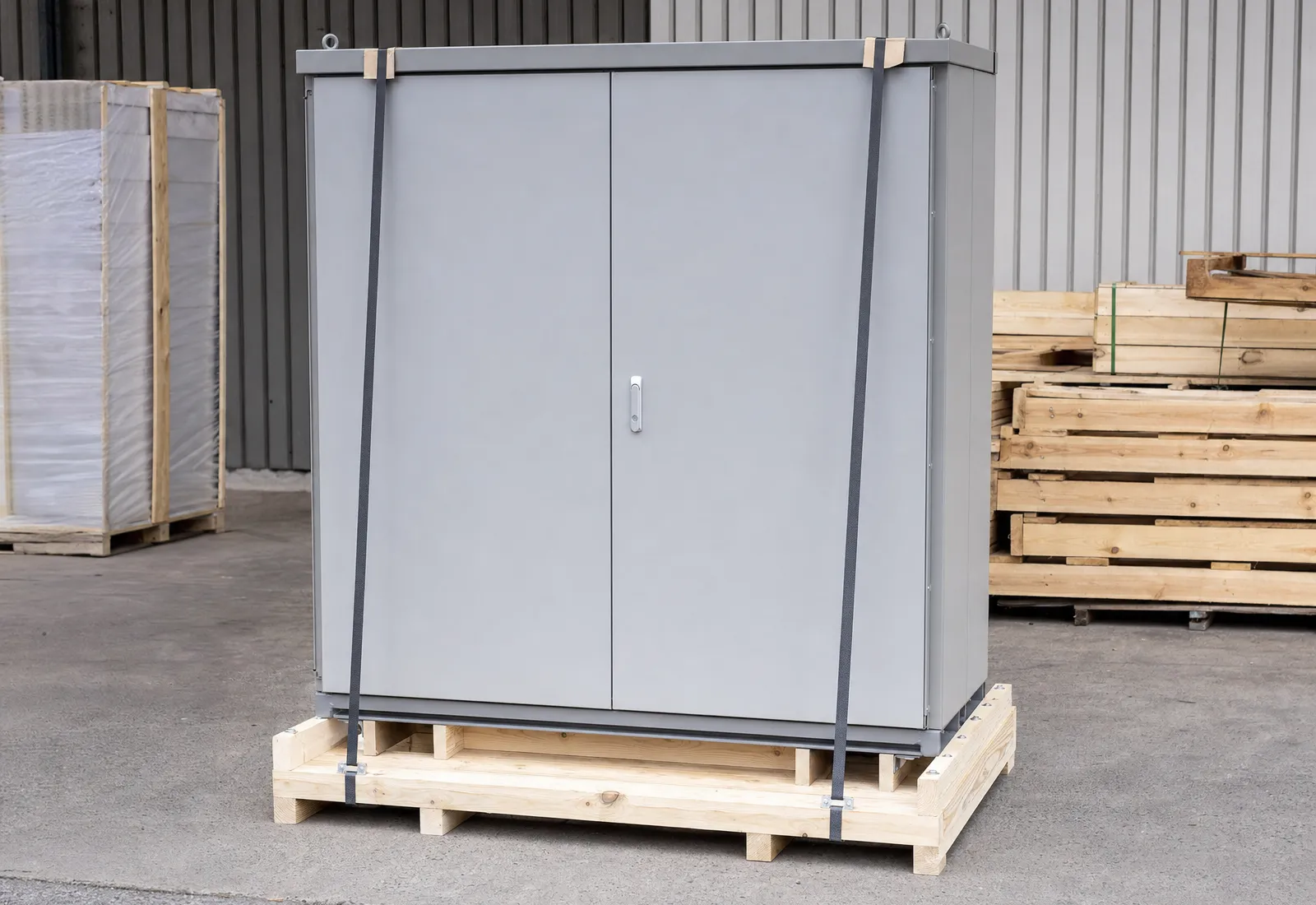
Equipment skids carry units that are shipped once and installed, or parked in storage until they are needed: control cabinets, generators, HVAC units, transformers, racks of electronics. The skid keeps the unit off the floor and gives forks somewhere to go.
- Cabinets, enclosures and packaged units.
- Equipment parked in a warehouse or yard before installation.
- Units that will be crated or shrink-wrapped on the skid.
| No. | Member | What it does |
|---|---|---|
| 1 | Deck boards | The only deck: there are no bottom boards. |
| 2 | Lead boards | The outside deck boards, where the load is strapped or bolted near the edge. |
| 3 | Runners | The skid’s stringers, sitting straight on the floor. |
| 4 | No bottom deck | A skid is moved by forks or a jack under the deck and mostly stays put. |
Sized to the unit
An equipment skid should be the unit’s footprint or a little larger, so the corners of the unit never overhang and take the hits. If the unit will be crated on the skid, the crate walls stand on the deck edges, so the skid grows by the thickness of the crate. Tell us which.
Storage and the deck
Equipment that waits in storage sits on its skid for weeks or months. A skid keeps it off a wet floor and lets air under it, and wood below 20% moisture content won’t support mold. Units stored outdoors need a deck that sheds water: leave gaps between deck boards, and say if the skid will stand on gravel or soil.
Tie-down points
Equipment is usually strapped or bolted to its skid for the truck. Strap slots, a wider lead board to bolt through, or cleats nailed to the deck to stop the unit sliding can all be drawn in. Mark where the unit’s mounting holes or lifting points are.
When a pallet is better
If the unit gets moved often, by pallet jack or across a conveyor, a full pallet with a bottom deck may serve better than a skid. The skid vs pallet guide sets the two side by side.
Crated or bare
Equipment that ships inside a crate sits on a skid that forms the crate’s base, and the skid must be wider than the unit by the crate wall and any blocking. Equipment that ships bare, wrapped in film, needs a skid sized flush to the unit so nothing overhangs and nothing tears the wrap. Say which, and give the unit’s footprint, height and weight; if it is top-heavy, mark where the centre of gravity sits.
Units stored on their skids for months, waiting for installation, need runners that stay straight under a constant load.
Electrical and lab equipment
Cabinets, panels and instruments are often light for their size but sensitive to shock. A flat, even deck, padding between unit and wood, and careful lifting matter more than raw strength. Say if the unit has handling instructions printed on its carton.
Storage before installation
Units delivered ahead of installation can wait for months in yards or warehouses. Dried lumber, runners that keep the unit off wet ground, and a deck that sheds water protect it meanwhile.
Moving equipment on a skid
Equipment skids are often moved more than once: from the shop to the truck, from the truck to a site, and again when the unit is installed. Runners tall enough for forklift tines, chamfered ends that let it be dragged or winched, and lifting points where a crane might pick it all belong on the sheet. Tie-down points, so chains or straps can secure it on a flatbed, are worth adding too.
Quote equipment skids
The unit’s footprint and weight, and whether it ships crated, wrapped or bare.
- Construction
- Skid (no bottom deck)
- Pallet size
- The skid’s footprint, runner length first
- Load weight
- The unit, in pounds
Not sure of a line? Leave it blank. Size, load weight and quantity are enough to start a quote.