New pallets and skids for machinery
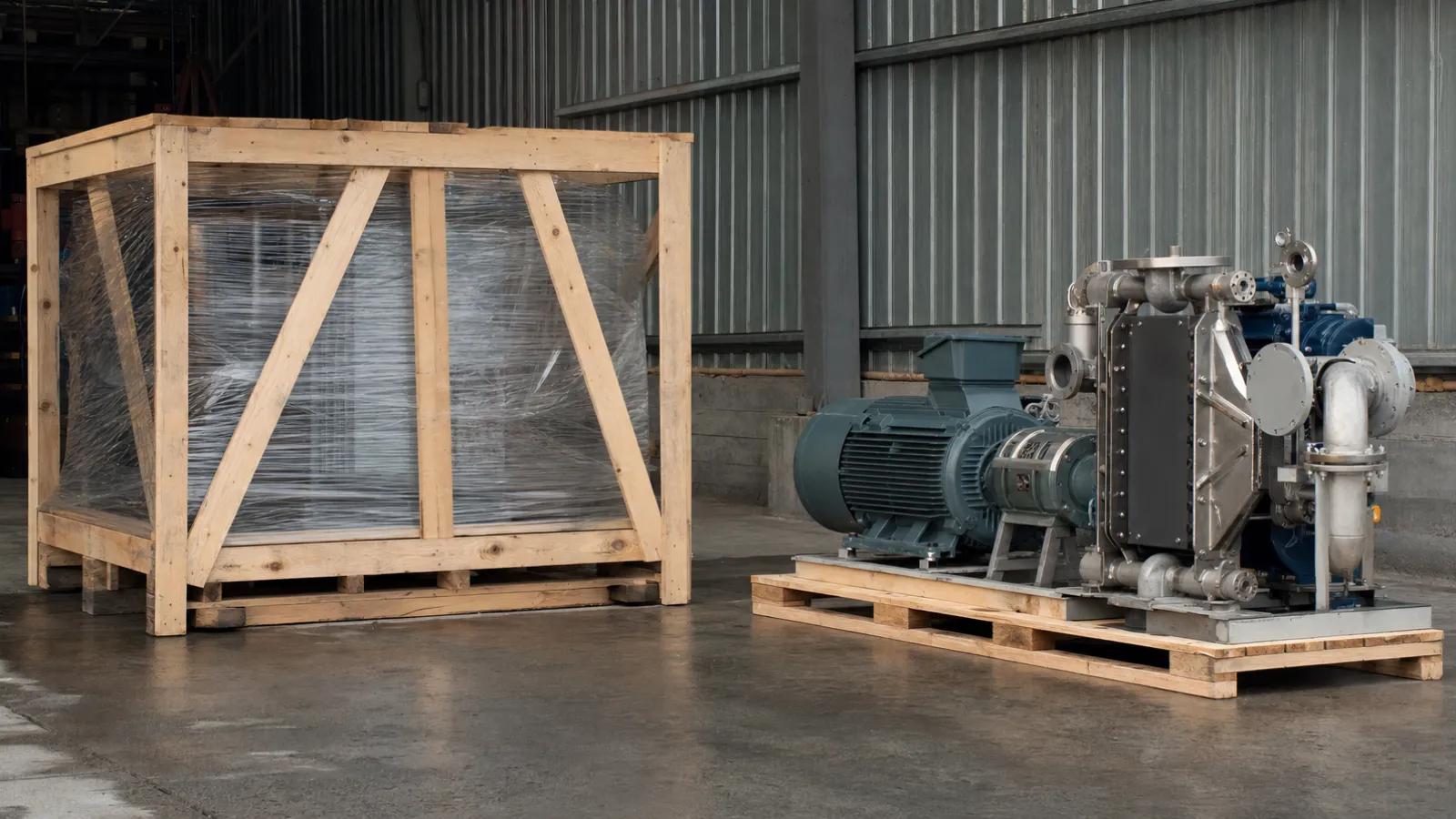
A machine is shipped once, bolted down, and set on a floor at the other end. The skid under it is drawn to the machine: its base, its feet, its weight and where the forks can go.
 Illustrative image
The load
Machines put their weight on a few feet or a frame, not across a deck, and many are top-heavy. They are bolted or lagged to the skid through holes in their base, and the runners must sit where those bolts land. A machine skid is lifted by forklift from beneath the deck or by crane, so there must be clearance for forks or slings.
What usually suits it
- Construction
- Machinery skid: runners, deck, no bottom deck
- Runners
- Under the machine’s feet and bolt holes
- Height
- Clearance for the forks
- Lumber
- Hardwood for heavy machines
| No. | Member | What it does |
|---|---|---|
| 1 | Deck boards | The only deck: there are no bottom boards. |
| 2 | Lead boards | The outside deck boards, where the load is strapped or bolted near the edge. |
| 3 | Runners | The skid’s stringers, sitting straight on the floor. |
| 4 | No bottom deck | A skid is moved by forks or a jack under the deck and mostly stays put. |
What to send
The machine’s weight and footprint, a drawing or photo of its base with the bolt holes, its center of gravity if it is top-heavy, and how it is lifted. If it ships in a crate, give the crate’s inside size.
Skid or pallet
Most machines ship on skids. A pallet with a bottom deck suits machines that are racked or moved on conveyors. Skid vs pallet explains the difference.
Heavy and odd sizes
Machines rarely fit a stock footprint. Oversized pallets and custom skids cover the rest.
Questions buyers ask
- Who supplies the bolts?
- Usually the shipper fixes the machine to the skid with its own hardware. We size the runners so they take the bolts without splitting, and leave the holes to you unless you send a drilling pattern.
- Can the skid stay under the machine?
- Often it does, as a base on the shop floor until installation. If it will, give its height limits and whether it must be removed with a forklift or jacks.
- What about crates?
- A crated machine sits on a skid that forms the crate floor. We quote the skid; the crate walls and lid are a separate trade.
- Export machinery?
- A skid that leaves the US needs the ISPM 15 treatment and mark. Name the destination country.
- How tall should the runners be?
- Tall enough that the tines of the forklift you use pass under the deck with room to spare, and tall enough for a pallet jack if one will move it. Measure the tine thickness and allow for a loaded deck that flexes slightly.
- Can a skid carry several small machines?
- Yes, if they are fixed down individually and the runners sit under each one. Give each machine’s footprint and weight and how they are arranged.
- What lumber suits a machinery skid?
- Hardwood runners for heavy machines, because they hold bolts and resist crushing under feet; pine decks are often enough. Very light units can go on an all-pine skid.
- Does the skid need to be painted or marked?
- Only if you or your customer require it. Some shippers stencil the order number or a center-of-gravity mark on the runners; tell us what is needed.
- Generators, compressors and pumps?
- These units carry engines, tanks or motors, often top-heavy, with fluids that may shift. A wide base, bolting through the frame, and drip trays where required all go on the request.
- Do buyers set rigging requirements?
- Some buyers and carriers ask for lifting points, a marked center of gravity, or skids that a crane can pick with slings. Send their requirement with the request and it goes on the sheet. Ask about hold-down bolts, drip trays and moisture barriers too, especially for ocean voyages.
Quote a machinery skid
Give the weight, footprint and bolt pattern.
- Industry
- Machinery
- Pallet size
- The machine’s footprint
- Load weight
- Per pallet, in pounds
Not sure of a line? Leave it blank. Size, load weight and quantity are enough to start a quote.