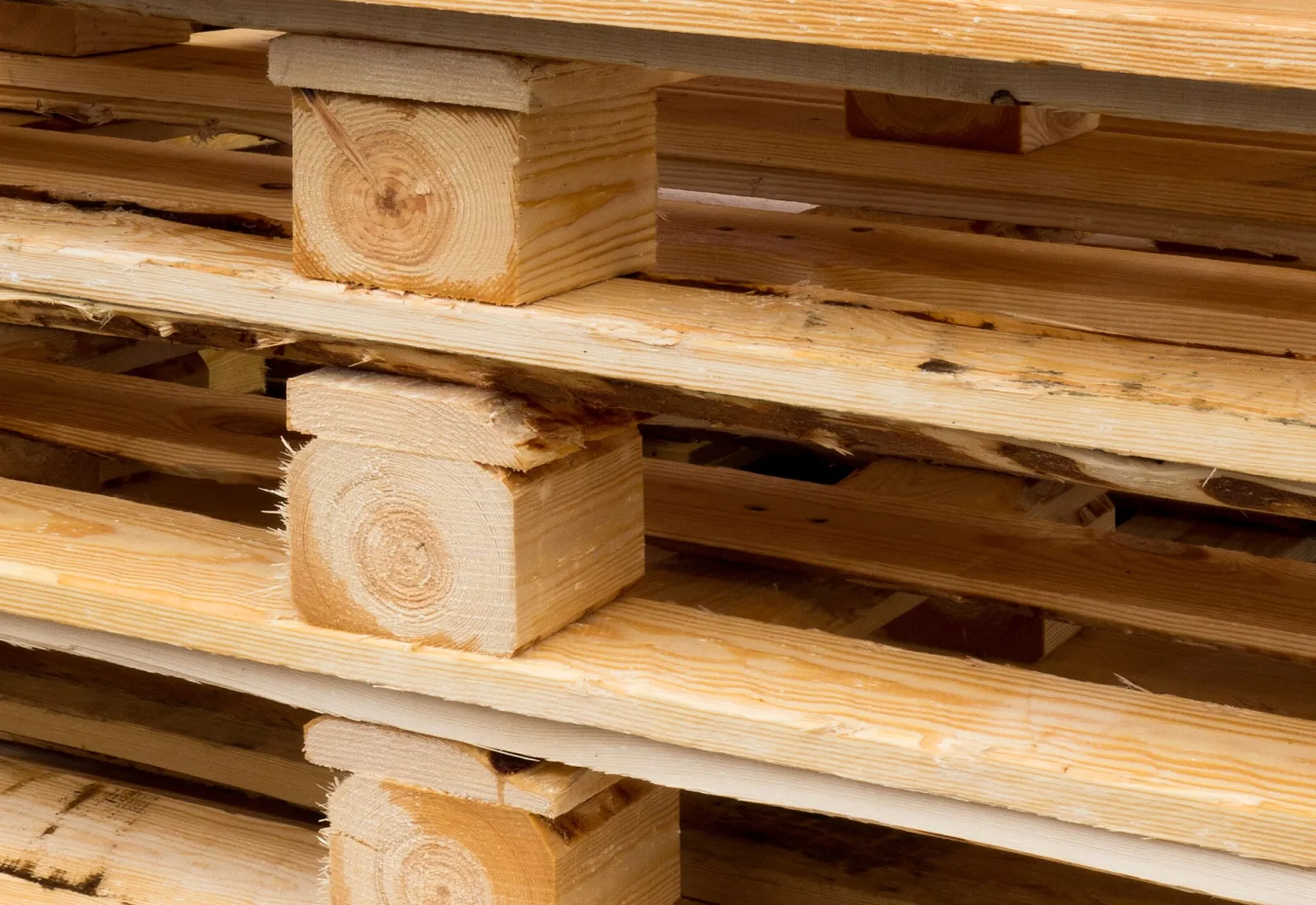
Hardwood and pine pallets
The lumber is the biggest choice inside a pallet after the size. Pallets use a great deal of both kinds: pallet production takes 43% of the hardwood and 15% of the softwood used in the US.
- Hardwood: dense, stiff, heavy loads and rough handling.
- Pine and other softwoods: lighter, cleaner, more even boards.
- Mixed builds: hardwood stringers under a softwood deck, or the reverse.
| No. | Member | What it does |
|---|---|---|
| 1 | Top deck boards | Run across the stringers; count and width set the deck coverage. |
| 2 | Lead boards | The deck board on each outside edge, top and bottom; the first board a fork meets. |
| 3 | Stringers | The long supports under the deck; their length is the first number in the size. |
| 4 | Bottom deck boards | Spread the load on the floor or a conveyor and tie the stringers together. |
Hardwood
Hardwood pallet lumber, the yellow-white and brown boards of oak, poplar and mixed species, is dense and stiff. At the same thickness it carries more and stands up better to a fork driven in hard, which is why heavy-duty builds lean on it. The cost is weight: a heavier empty pallet is more freight and more to lift by hand. Hardwood boards also vary more in colour and grain from board to board.
Pine and other softwoods
Southern yellow pine and other softwoods give pale, even boards that are lighter for the same size. For light and medium loads, clean freight such as food and retail goods, and pallets that are lifted by hand or shipped by weight, softwood is usually the right lumber. To carry more, a softwood build adds boards or thickness rather than changing species.
What changes in the spec
The lumber changes the board sizes the design needs. Pallet makers size boards to a load in PDS, the Pallet Design System, which takes the species into account: a deck that works in hardwood at one thickness may need to be thicker, or have more boards, in pine. Board feet set much of the price, so the cheaper lumber per board foot isn’t always the cheaper pallet. We quote the lumber that suits the load, and say why.
Moisture
Fresh-sawn lumber of either kind is wet. Wood below 20% moisture content won’t support mold, so if your pallets sit closed up in trailers or containers, or carry food, ask for dried lumber or kiln drying and it is written into the spec.
Lumber and fasteners
Nails hold differently in hardwood and softwood. Dense hardwood grips a nail hard but can split if the nail is too big or too close to an end; softwood splits less but holds less. Pallet builders choose nail type, length and spacing with the lumber, which is one more reason the species belongs on the written spec rather than being left open. Mixed builds are common: hardwood stringers carry the load while a softwood deck keeps the weight down.
Telling the species apart
Hardwood boards are usually heavier in the hand, darker and closer-grained; pine is paler, lighter, resinous and often knotty. Mixed hardwood varies from board to board, which is normal. If one species matters to you, write it on the sheet, because otherwise a mill uses whatever lumber it has. Oak, maple and poplar are common hardwoods; southern yellow pine is a common softwood. Freshly sawn boards smell sharply of sap; dried ones barely do.
Quote pallets in the lumber that fits
Say which lumber you want, or tell us the load and handling and leave the choice to the spec.
- Lumber
- Hardwood, pine or not sure
- Pallet size
- Stringer length first
- Load weight
- Per pallet, in pounds
Not sure of a line? Leave it blank. Size, load weight and quantity are enough to start a quote.