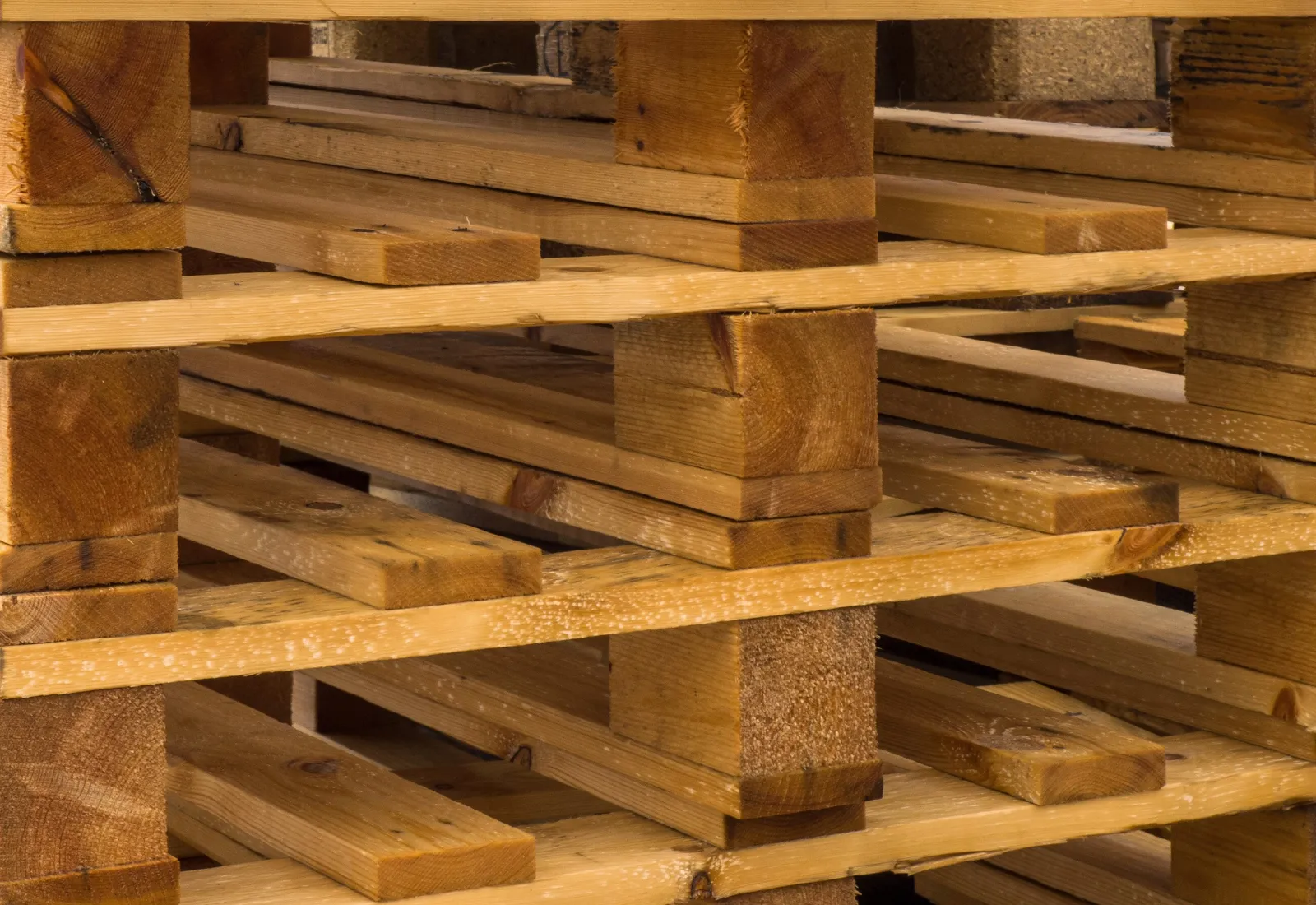
New block pallets
A block pallet stands on blocks instead of stringers, usually nine: one at each corner, one at the middle of each side and one in the centre. With nothing running the full length underneath, forks and pallet jacks can enter from all four sides.
- Heavy loads handled again and again, in and out of racking.
- Docks and warehouses where pallet jacks come at the pallet from any side.
- Automated lines and conveyors that want a bottom deck running both ways.
| No. | Member | What it does |
|---|---|---|
| 1 | Top deck boards | Nailed to the stringerboards across the blocks. |
| 2 | Lead boards | The outside deck boards, top and bottom. |
| 3 | Blocks | Nine posts between the decks; forks enter on every side. |
| 4 | Bottom deck boards | Run both ways on many block builds, which helps on conveyors and racking. |
Why a block build
The case for a block pallet is handling. A stringer pallet with notches lets forklifts in from the sides but not pallet jacks; a block pallet takes both from every side, which is called true four-way entry. Four-way pallets are lifted by the stringers and are usually heavier, bigger and more durable than two-way pallets. In a warehouse where loads get turned, picked and racked many times, that matters more than the extra lumber.
What a block build costs you
More wood and more nails. The blocks, the stringerboards that tie them together under the top deck, and a bottom deck that often runs both ways all add board feet, and board feet set most of a pallet’s price. For one-way freight that is unloaded once and never seen again, a stringer pallet usually does the job for less.
Blocks, stringerboards and the deck
The blocks are solid wood, sized to the height you need for fork entry. Stringerboards run across the tops of the blocks and the top deck is nailed to them. The bottom deck is where block builds vary most: boards one way only, or both ways in a frame, which spreads the weight better on conveyor rollers and rack beams. Lead boards sit on every outside edge and take the first hit from a fork, so they are often specified heavier.
Sizes
Block pallets are built on the same footprints as stringer pallets, 48 x 40 most of all, and on custom footprints. The size is still written with the length first; on a block pallet that is the side the stringerboards run along. If you are matching a pallet you already use, measure both sides and tell us which way the top deck boards run.
Pooled and closed-loop pallets
Rental pools and closed-loop systems favour block pallets because they survive many trips through many hands. If your pallets circulate between your own sites, a supplier and a customer, and come back to you, a block build usually pays for its extra lumber over the trips it lasts. If they leave and never return, it rarely does. Tell us which, and roughly how many trips you expect, and the quote reflects it. Repairs matter too: a block pallet with a broken block is fixed by replacing that part.
Automated warehouses that move pallets on chain conveyors and shuttles often require block pallets with a bottom deck in both directions, because the runners must be supported whichever way the pallet travels. If your building has a pallet specification for its automation, send it.
Checking a block pallet
Blocks should sit square under the stringer boards, with nails clinched or driven flush, never protruding into the openings. Measure the openings’ height and width against your pallet jack and forklift tines. On a full-perimeter bottom, check that the boards lie flat, so the pallet sits evenly on conveyors and floors.
Quote block pallets
The load weight, how often it is handled and whether it goes in racking tell us how to build the decks.
- Construction
- Block
- Pallet size
- Your size, stringer length first
- Load weight
- Per pallet, in pounds
Not sure of a line? Leave it blank. Size, load weight and quantity are enough to start a quote.