 Illustrative image
Machinery skids
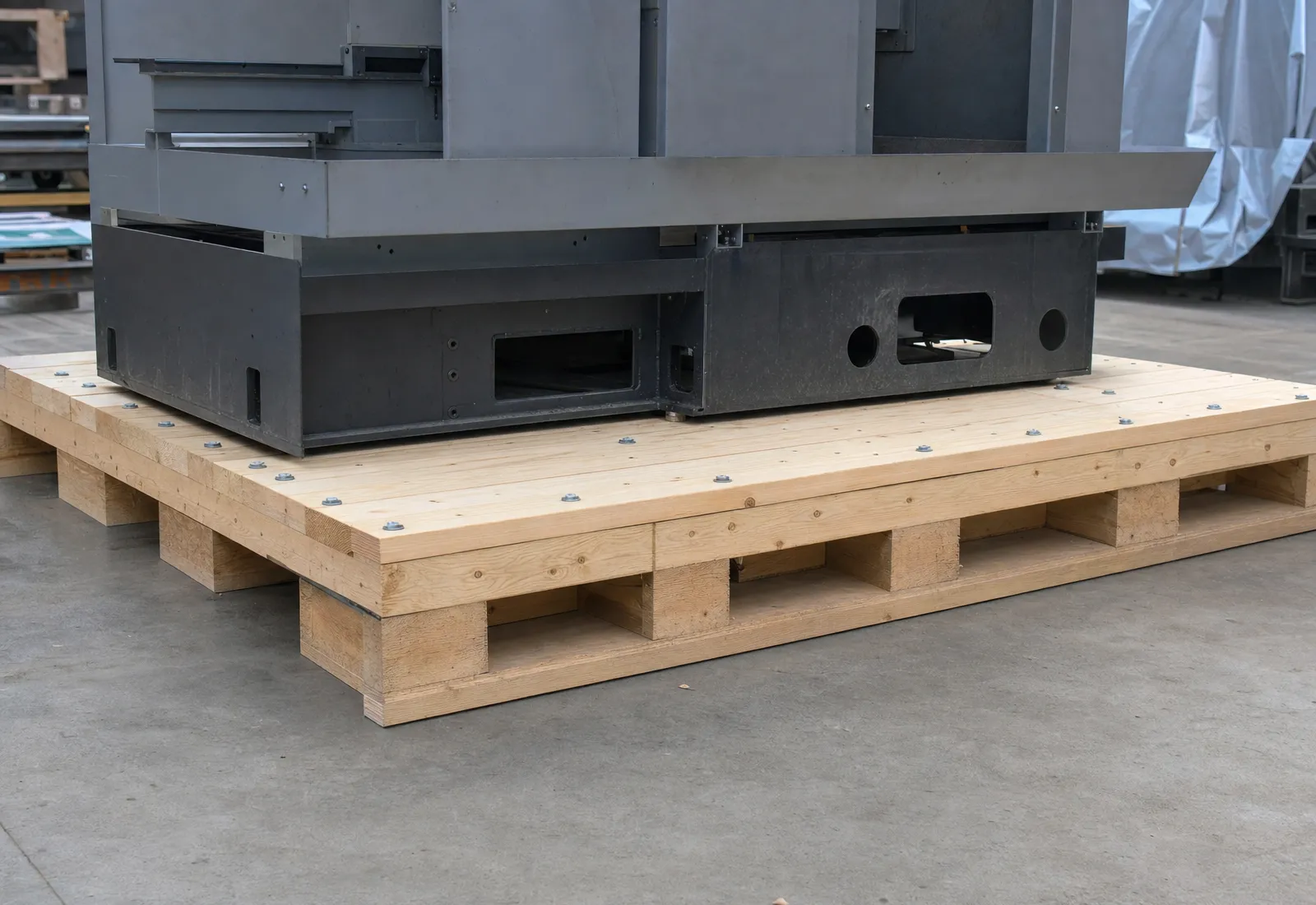
A machinery skid carries a machine tool, press, compressor or production unit from the builder’s floor to yours. It is drawn around the machine: runners under its feet, deck boards where it bolts down, and room for forks where your rigger needs them.
- Machine tools, presses and production equipment.
- Machines bolted down through the deck for shipping.
- One skid per machine, or a batch for a product line.
| No. | Member | What it does |
|---|---|---|
| 1 | Deck boards | The only deck: there are no bottom boards. |
| 2 | Lead boards | The outside deck boards, where the load is strapped or bolted near the edge. |
| 3 | Runners | The skid’s stringers, sitting straight on the floor. |
| 4 | No bottom deck | A skid is moved by forks or a jack under the deck and mostly stays put. |
Runners under the feet
A machine stands on feet or a base frame, so its weight comes down on a few points. Put a runner directly under each line of feet, and the load goes straight to the floor through solid wood instead of bending a deck board. Send the machine’s footprint and the position of its feet or frame, and the runners are spaced from that.
Bolting down
Machines usually ship bolted through the skid. Mark the bolt holes on the drawing, and full deck boards, or blocking between the runners, go under each one, so the bolts clamp onto wood and not a gap. Lag bolts and through-bolts both need wood thick enough to hold them; say which your crew uses.
Height and fork entry
The runners set how high the deck stands off the floor, and that sets which forks and jacks fit underneath. Standard runners leave room for forklift forks from the two ends; a pallet jack needs more height and no bottom boards in the way, which a skid already gives. If the machine will be lifted from the side, tell us, and the runners are notched or spaced for it.
Weight and balance
Give the machine’s shipping weight and where its centre of gravity sits if it is far from the middle. A top-heavy or lopsided machine needs runners placed to keep it from tipping when lifted. For very dense machines, see heavy-duty skids.
Rigging and receiving
Machines often arrive at a plant that has no dock, and are rigged off the truck with a forklift, a crane or rollers. Each method needs something from the skid: fork pockets with enough height for the tines, lifting points clear of the deck for slings, or a flat runner bottom that rides on skates. Tell us how the machine leaves your building and how it enters the next one, and the runners are sized for both ends of the trip.
Machines shipped for export also need the ISPM 15 treatment and mark on the skid; name the destination country on the request.
Bolting down
Bolts or lag screws through the machine’s base into the runners are the usual fixing. The runners must be thick enough to take them without splitting, and wide enough that the holes land in solid wood.
Vibration in transit
Long truck journeys shake a machine on its skid for hours. Tight fixings, blocking against sideways movement and a skid that doesn’t flex keep alignment and paintwork intact. Mention delicate parts such as spindles, glass guards or control panels.
Before the machine goes on
Check that the runners lie flat and parallel, and that the bolt positions match the machine’s feet, before lifting anything onto the skid. A center-of-gravity mark on the side helps riggers and forklift drivers lift a top-heavy unit level. Photograph the fixed machine for your shipping records.
Quote a machinery skid
The machine’s footprint and weight, where its feet sit and where it bolts down.
- Construction
- Skid (no bottom deck)
- Pallet size
- The skid’s footprint, runner length first
- Load weight
- Shipping weight of the machine
Not sure of a line? Leave it blank. Size, load weight and quantity are enough to start a quote.