 Illustrative image
New stringer pallets
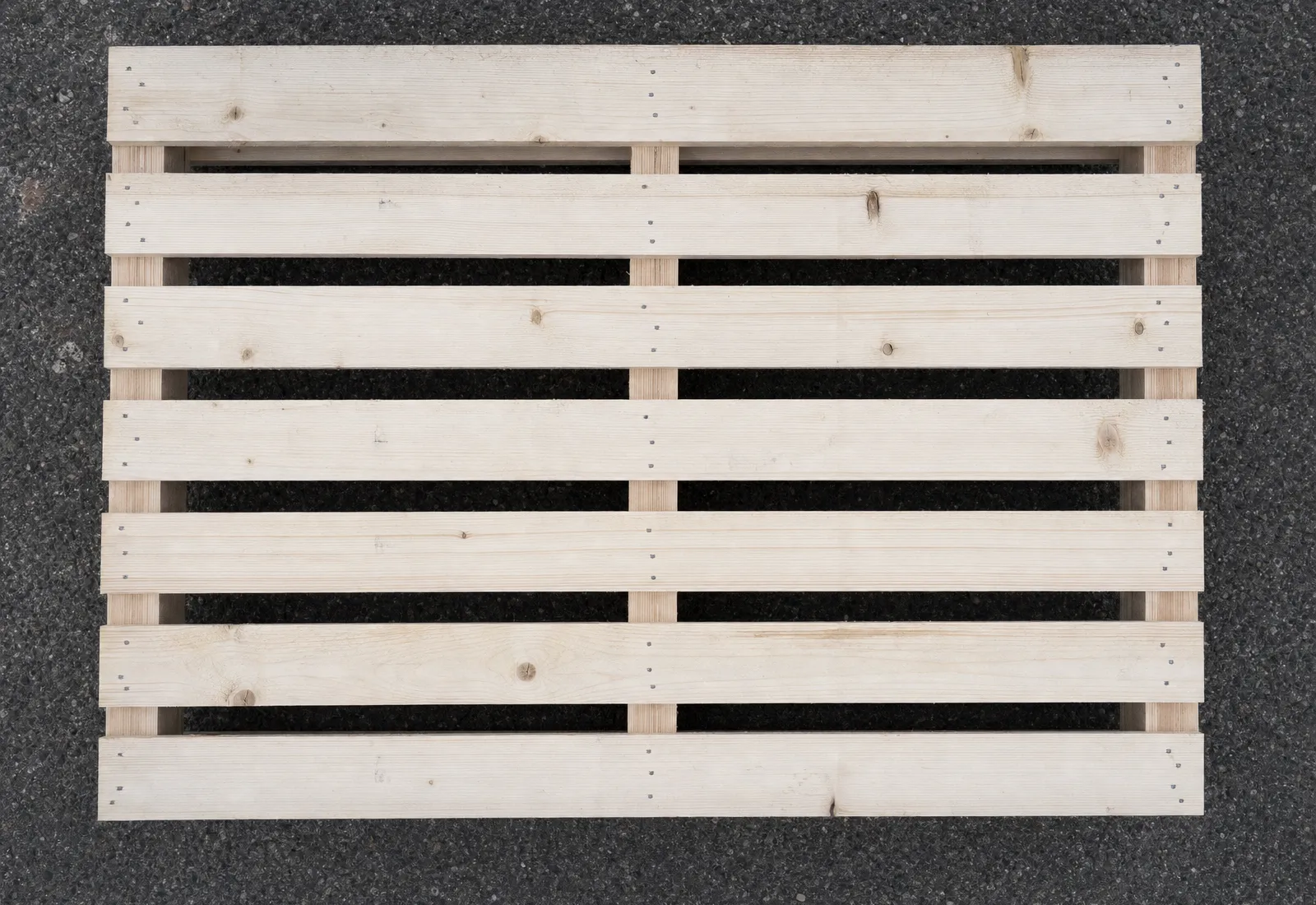
A stringer pallet sits on three or more long boards, the stringers, with deck boards nailed across them top and bottom. It is the common American pallet: more than 80% of US pallets are stringer builds, by one large maker’s count.
- Plant-to-warehouse and outbound freight on a common footprint.
- Loads moved mostly from the two ends, or from the sides once the stringers are notched.
- Buyers who want the most pallet for the lumber.
| No. | Member | What it does |
|---|---|---|
| 1 | Top deck boards | Run across the stringers; count and width set the deck coverage. |
| 2 | Lead boards | The deck board on each outside edge, top and bottom. |
| 3 | Notched stringers | Cut-outs in the outside and centre stringers let forks enter from the sides: partial four-way entry. |
| 4 | Bottom deck boards | Placed clear of the notches so the forks can pass. |
Two-way or notched
A plain stringer pallet takes forks from the two ends, between the stringers. Cut notches into the stringers and forklift forks can come in from the sides as well, which is called partial four-way entry. A pallet jack still can’t, because its wheels need the open space a block pallet has. If your trucks and jacks only ever lift from the ends, the notches cost strength you don’t need. Two-way and four-way entry explains the difference with drawings.
Notches are cut to a standard shape and depth so forks of common sizes pass through; if your forks are unusually wide or thick, measure them and include the numbers.
A notch also weakens a stringer, so notched pallets carrying racked loads may need taller stock.How many stringers
Three stringers is the standard US build, one under each edge and one down the middle. A fourth or fifth shortens the span of every deck board and spreads a heavy load across more wood; it is how a stringer pallet becomes a heavy-duty pallet. Stringer length sets the first number in the size, so a 48 x 40 has 48-inch stringers.
The deck
Deck boards run across the stringers. The outside board on each edge, top and bottom, is the lead board, and because it takes the first hit from a fork it is often specified wider or thicker. A top deck of seven boards is typical on a 48 x 40; small cartons and bags need closer spacing so nothing drops through. Deck boards and lead boards covers coverage and spacing.
Sizes and load figures
The common stringer sizes are 48 x 40, 48 x 42, 48 x 44, 48 x 45, 48 x 48, 42 x 48, 36 x 36, 32 x 30 and 30 x 30. Published figures for a standard 48 x 40 put its capacity at 2,000 to 2,800 lb moving and 2,500 to 4,600 lb at rest, and its empty weight at 33 to 49 lb. Those are the trade’s numbers for a typical build, not a rating for yours: a quoted pallet is worked out from your load. See the sizes for each footprint.
What to tell us
Four answers settle most stringer builds: the size, stringer length first; the heaviest load a pallet will carry; whether forklifts, pallet jacks or both handle it, and from which sides; and whether it is floor-stacked, stacked loaded or racked across beams. With those, the stringer count, notches, deck boards and lumber follow. Quantity and the delivery ZIP complete the quote. If you already use a stringer pallet that works, measure it and send the numbers: we can write the same build down, or suggest where it carries more wood than the load needs.
Checking a stringer pallet on arrival
Look along each stringer for splits running from nail holes, and at the notches for cracks at the corners, where a notched stringer is weakest. Lay a straightedge across the top deck. A pallet that rocks on the floor or racks out of square feeds badly into conveyors and stretch wrappers.
Quote stringer pallets
Tell us the size and the load, and whether forks need to come in from the sides.
- Construction
- Stringer (say if it needs notches)
- Pallet size
- Your size, stringer length first
- Load weight
- Per pallet, in pounds
Not sure of a line? Leave it blank. Size, load weight and quantity are enough to start a quote.