 Illustrative image
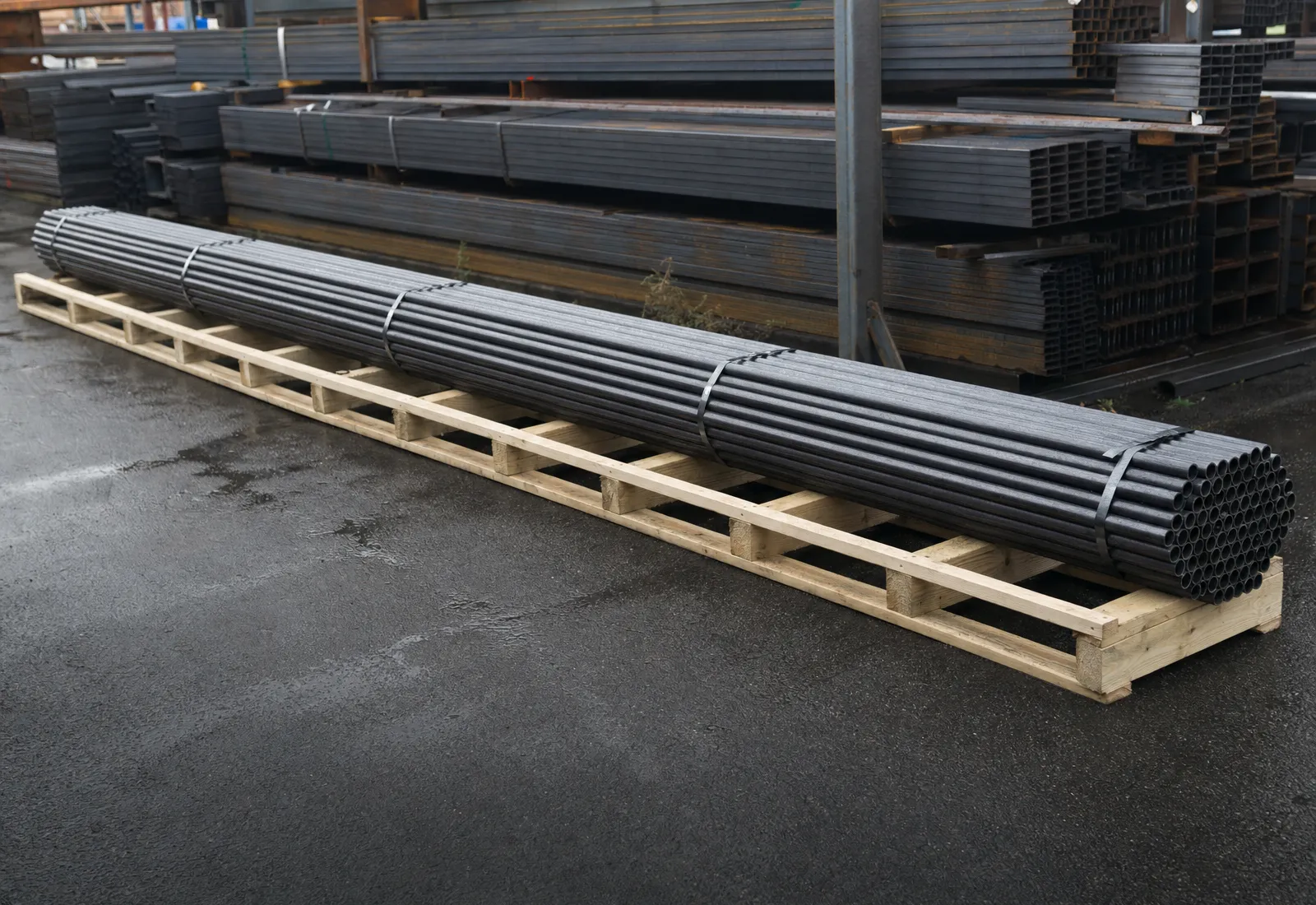
Long pallets for long loads
A long pallet carries goods that are much longer than they are wide: pipe, tube, bar, extrusions, lumber, doors and trim. The stringers run the length of the load, so the length is the first number in the size.
- Pipe, tube and bar in banded bundles.
- Aluminium and plastic extrusions, trim and mouldings.
- Doors, panels and boards shipped flat.
| No. | Member | What it does |
|---|---|---|
| 1 | Top deck boards | More of them, closer together, for dense or point loads. |
| 2 | Lead boards | Often specified thicker on a heavy build, since they take the first hit. |
| 3 | Stringers | Four or more, so the deck boards span less between supports. |
| 4 | Bottom deck boards | A fuller bottom deck spreads the weight on a floor or rack. |
Stringer length and stiffness
On a long pallet the stringers do most of the work. They carry the load end to end and have to stay straight when the pallet is lifted from the middle. Long stringers are usually thicker, and some builds join two stringers end to end with a splice; tell us if your loads are lifted at the ends, at the middle or from the side, because that decides where the stringers need their strength.
Fork entry from the side
Long pallets are usually lifted from the long side, across the stringers, which is the opposite of a 48 x 40. That means notches in the stringers, or a block build, so the forks can pass under the deck. Plan the notches around where the load’s weight sits and where your forks are spaced. Two-way and four-way entry shows how the notches work.
Deck boards for long loads
Long loads need fewer, wider deck boards than cartons do, but they need them where the bundle rests and where bands go round. Leave gaps for banding or straps, and put full boards under the bundle’s dunnage or blocking. If the load can roll, as pipe can, chocks or a cradle can be nailed to the deck as part of the build.
Common lengths
Long pallets follow the product, so there is no list to choose from. 96 x 48, an eight-foot footprint, has its own page with a drawing. Send the product’s length and the overhang you will accept at each end.
Overhang and banding
Some long goods are allowed to overhang the pallet ends by a few inches; others must not overhang at all. Decide how much is acceptable before the pallet is drawn, because each inch of pallet you save is an inch of load in the air. Bands that hold a bundle to the pallet need room to pass under the deck between stringers, so tell us how many bands you use and where they go, and the gaps are left in the right places.
Pipe and round bar want to roll. Chocks, wedges or a shaped cradle nailed across the deck hold them in place; tell us the diameter and how many pieces sit side by side in a layer, and those parts are drawn into the build.
Extrusions and trim scratch easily, so some buyers want the deck boards planed smooth or covered; say if the finish of your product matters. Painted or anodized profiles may need protective strips between product and wood.
Handling long pallets
Long pallets flex between supports, so lifting one with forks set close together lets both ends droop. Spread the forks as wide as the truck allows, or use fork extensions on very long builds. Storing them flat on level dunnage stops a permanent bow forming before they’re loaded. Mark the center on each side so drivers find it quickly.
Quote long pallets
Give the load’s length, weight and how many bundles go on each pallet, and which side the forks come from.
- Construction
- Stringer or block, if you know
- Pallet size
- Length first, then width
- Load weight
- Per pallet, in pounds
Not sure of a line? Leave it blank. Size, load weight and quantity are enough to start a quote.